Jump to content


Riblet cable clips


9 replies to this topic

#1 Limelight

    Established User

  • Industry I
  • 314 Posts:

Posted 13 October 2006 - 06:25 PM

For those who've spent some time working with the Riblet clips, I'm curious on the what kind of issues or problems if any you came across.

Were there ever any cases of the clip slipping through the rope? And by slipping I mean both down the length or out the side.

What kind of annual maintenance was required?

Was using the hydraulic equipment used for both removing and installing the clip every challenging or dangerous? And how long would it take to install or remove each clip?

Posted Image

Posted Image

This post has been edited by Limelight: 13 October 2006 - 06:28 PM


#2 liftmech

    lift mechanic

  • Administrator II
  • 5,918 Posts:
  • Interests:Many.

Posted 13 October 2006 - 06:36 PM

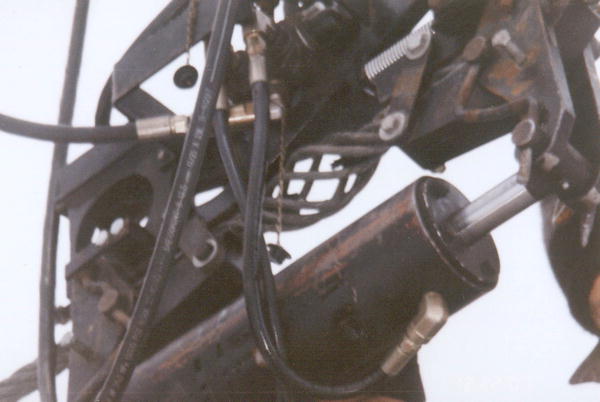
Nice picture of the Riblet finger-smasher.

In normal operation the clips don't move. Now, I did say 'normal'. I've experienced one popping out (and heard of several others). I had an operator send a shovel from top to bottom on Baker's chair 1. The bottom terminal is an ancient open-framework style, with barely enough room for the chairs as they round the bullwheel. The shovel handle caught on the frame and twisted the chair enough to pop the clip out.

Annual maintenance, aside from the moving shown above, is very minimal. Clean the thing up and move it back a foot. There's only the one piece to it.

The detensioner is heavy and awkward to move. It is capable of removing the tension from a foot of rope, whether it's high or low. So yes, it can be dangerous. Use it properly and you won't have a problem. For some reason a 10-minute total time for moving sticks in my mind, from start to finish. Theis includes cleaning out the chairhead bushings and re-lubing them once the chair's been put back on the clip.

You can see the opened rope in the picture above. When I first started wrenching on Riblets, my boss stuck our fishing knife (we were using it to cut core) in the 'birdcage' and hit the release on the detensioner. The resulting abrupt tightening of the rope snapped the blade in half. He then told me never to stick my fingers in the 'birdcage'.
Member, Department of Ancient Technology, Colorado chapter.


#3 Limelight

    Established User

  • Industry I
  • 314 Posts:

Posted 13 October 2006 - 06:43 PM

Yeah, I could see that being a great finger remover!

Why would you reinstall the clip back by a foot? Was this an annual requirement?

#4 Allan

    Maintenance Manager

  • Administrator I
  • 2,745 Posts:

Posted 13 October 2006 - 07:15 PM

Relocating fixed grips is required at a specified interval set by the manufacturer, for most it's every year... Another example of a shorter relocation interval is a t-bar like ours which has an relocation interval of 100 hours of operation - which is basically bi-weekly.
- Allan

#5 skier691

    skier691

  • Validating
  • 553 Posts:

Posted 14 October 2006 - 03:21 AM

Ill add... the main reason to move the clip back is to eliminate the stress that is on the strand of cable that passes thru the 'notch' in the clip. Leave the clip in the location past the recomm. time and you will most likely find one or two broken wires, not an ideal situation

#6 Limelight

    Established User

  • Industry I
  • 314 Posts:

Posted 14 October 2006 - 09:23 AM

Great, thanks for the info guys.

#7 Splicer

    Established User

  • Industry II
  • 63 Posts:

Posted 14 October 2006 - 04:26 PM

Clip plugs: I recommend to my customers to use 7/16" Delrin for 1-1/8" ropes, 1/2" low density polyethelene for 1-1/4" ropes, 9/16" delrin for 1-3/8" ropes. It tends to look slightly big in the rope but works quite well. The formula for core size is .398 X the nominal rope diameter. You can order the rod from McMaster-Carr.

#8 liftmech

    lift mechanic

  • Administrator II
  • 5,918 Posts:
  • Interests:Many.

Posted 17 October 2006 - 04:55 AM

Those are exactly the plugs I recall using. We had one 1 1/2" rope as well with the #9C clips- our detensioner almost wasn't big enough to handle those suckers and it required finesse (and sometimes a large brass hammer) to get them in.
Member, Department of Ancient Technology, Colorado chapter.

#9 cjb

    Established User

  • Industry II
  • 598 Posts:
  • Interests:cycling, snowboarding, running, scuba

Posted 17 October 2006 - 01:56 PM

There were other requirements for riblet clip inspections that I can't exactly remember. I think there was a monthly visual inspection of the clip and rope along with the bi-annual relocation.

#10 aug

    Lift Maint. Manager

  • Industry II
  • 745 Posts:
  • Interests:Flatlander heckling

Posted 17 October 2006 - 02:45 PM

Don' forget the periodic N.D.T. inspection. 100% over 6 years.
"Maybe there is no Heaven. Or maybe this is all pure gibberish—a product of the demented imagination of a lazy drunken hillbilly with a heart full of hate who has found a way to live out where the real winds blow—to sleep late, have fun, get wild, drink whisky, and drive fast on empty streets with nothing in mind except falling in love and not getting arrested . . . Res ipsa loquitur (it speaks for it self). Let the good times roll." HT


12 User(s) are reading this topic

0 members, 12 guests, 0 anonymous users